The Earthquake
In 1971 Mother visited me in Arcadia during a time Doug was staying with us. One afternoon while the three of us sipped tea around the kitchen table, with our promp ting she·again recounted her memories of the long ago earthquake. Much of·the following is transcribed from the tape I fortuitously made. It was April 18, 1906. Just above the horizon the ea efR.sky showed a dim glow of the new da when without warning sharp vicious jolts tore the ·city asunder. Build ings swayed and crashed in crumpled heaps, street cars flew off their tracks and rails rose and buckled -appear ing as strange bows in the streets. Helen was awakened PY the loud rumbling of windows and a low groaning that seemed to surround her as the frame house on Clay Street lurched with the movement of the suddenly uncertain ground on which it stood. Even her comforting bed was about to toss her out. The chimney bricks came cascading past her window in a thunderous roar. Miraculously Mama appeared in the door. Belen leaped across the room and clung tightly to the loose flowing robe Clara had wrapped about herself. From some where Papa, holding Leland, appeared and they all huddled fearfully in the doorway. “It’s an earthquake,” Clara said, as if naming what was happening would make it less frightening. Helen could hear dishes fly out of kitchen cabinets and shatter on the hard carpetless wood beneath. Once steady floors became roller coasters and furniture slid crazily about. Suddenly the movement, the clatter ceased. It was breathlessly quiet. “Everyone get your clothes on as fast as you can. Don’t forget a coat. It’s cold outside,” Clara ordered, trying to keep her voice steady. The dressing was interrupted with dashes to the door way where they clasped each other in terror as a smaller temblor exploded. Clara, however, under even such harrowing circum stances was not going to appear outside in her night 1 clothes. Mother told us, “I can remember walking bare foot over things that felt like hard worms, but later I found it was 1 the matches that we kept to light the gas lights.” When the family did go out they saw the distant sky 1 already reddening with flames, though their house near Presidio Avenue was a long way from the fires. Later, came that people in our neighborhood were to go to the 1 “I think it was the next day,” Mother said, “the order Presidio to stay for an indefinite time. Others went to Golden Gate Park. “It was a great exodus,” she contiued, “It looked like 1 pictures you see of war refugees. People dragged special belongings with them, like a rocking chair, a baby’s crib, 1 the tents, we noticed that right next to the tent assigned 1 “When we went to the Presidio and they were putting up to us was Wong, the Chinese cook and his family. He had been with us in the Jackson Street house. Grandma was very friendly with the cook, you know the earthquake was a sort of leveler,” Mother laughed. “Ther•were hardly any spaces ..between the_tents. ‘!’ 1 were .set up very close together. Row af er- Tow of them. 1hey were eree-tad t,y ne so!die:rs there. There was no roof, just an outside wall to give us some privacy, I .1 guess. We used sheets inside to divide it into two rooms. “People kept coming in all during that first night and places were allotted to them. The army kept track of everyone. They had your name, which you gave as you came in and then they assigned you a place. “The army supplied most of the bread. They’d bring in these big loaves of bread and deliver them from horses. Everyone was very friendly. It was camping out, and for us kids it was fun. We were prepared to stay for a long time. We didn’t think we’d ever get home again. But we did. I don’t know how long it was.” When they returned to the Clay Street house living
front of the house. Everyone did that for a while. He was a good cook. Even Mom thought so. “And we had to get our water from a water wagon that came by each day. We’d all go out with buckets and pots and pans and get as much as they would allow us. Every body put it in their bathtubs to keep. In those days most people had only one bathroom, so that meant sponge bathes for a while. “Schools were used as supply depots. We used to have to stand in long lines waiting for allotted food. “After the cleanup began, the army gave huge tents to people if they needed it for anything. Your grandpa, and many men got-these tents. The city then built large plat forms along the waterfront near the ferry building. Peo ple put up these tents on the platforms and opened up coffee houses and restaurants. Grandpa put up his tent an opened a restaurant where he did most of the cooking. They did this, and nothing had come along—the City was still all a shambles. “Then later Papa rented a building on Clay Street, where Clay comes down to the Ferry building. He opened up a restaurant and I guess they had pretty close to thirty tables there. Many of their friends came to work in it. So many people had lost their businesses in the fire and of course their homes, too. My music teacher, Mrs. von Roheim was one of the waitresses. Grandma worked there, too, in the kitchen–making salads. She didn’t work there very long, though, but Grandpa kept it up. We moved to Mill Valley and Grandma stayed home wi h Leland and me. [I wonder if they went to the house Jerome had bought in 1890i where Florence and he had entertained the Douglass family?] I went to school there. “Papa commuted to the restaurant each day and got home every night about ten o’clock. In the morning he walked
·1 to a local train, which he took to the Mill Valley depot,
‘J J …….
‘J
about a mile away, then he took the electric train to Sausilito. The little local train didn’t run at night, so he carried a kerosene lamp and walked home from the depot in Mill Valley. ‘‘This one night when he got home, after ten o’clock I suppose. He couldn’t remember whether he’d turned off the gas at the restaurant. So he turned around and walked the mile back to the Mill Valley depot, rode the train to Sausilito and the ferry to the City and back again. The next morning he told us, ‘I had already turned it off.’ But, of course he had been afraid the place would be burn-. ed down if he didn’t check.”
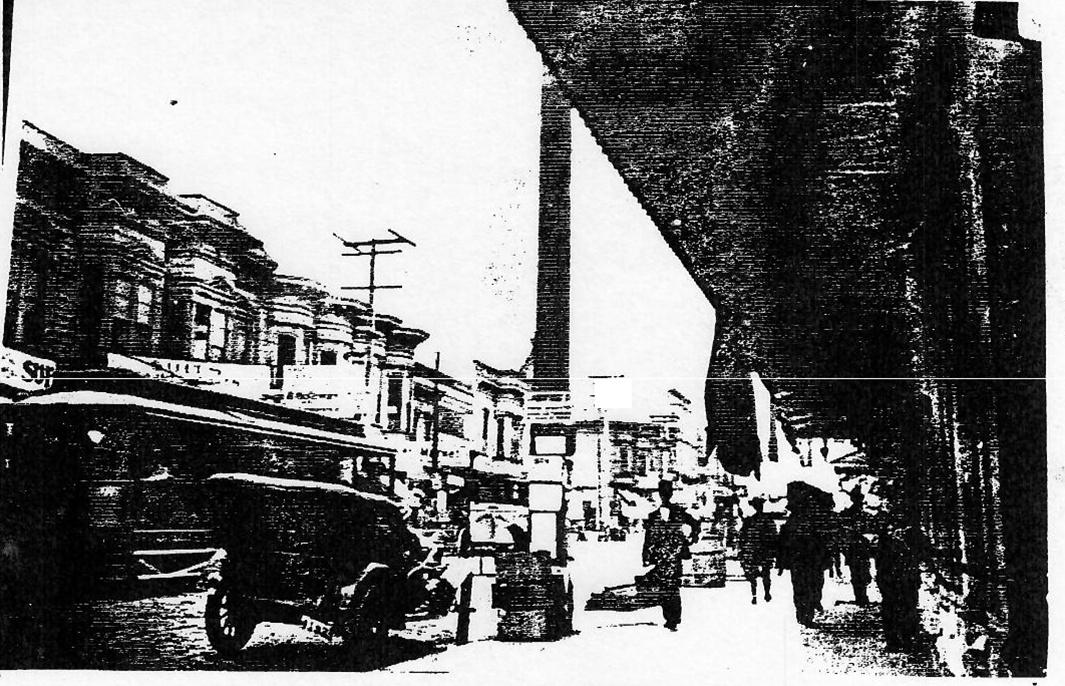
Filmore Street, San Fransisco 1906
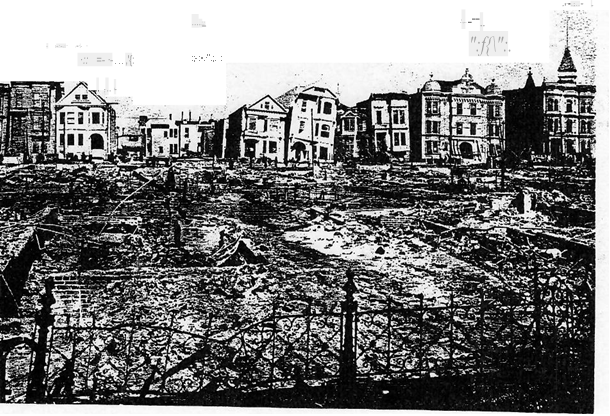
San Francisco Earthquake April 18, 1906
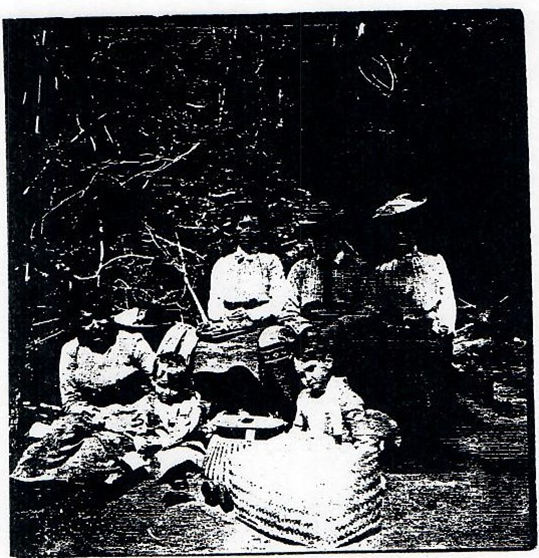
Sunday picnic at the beach Mable, Charlie & Claras elma (nursmaid), Leland & Helen
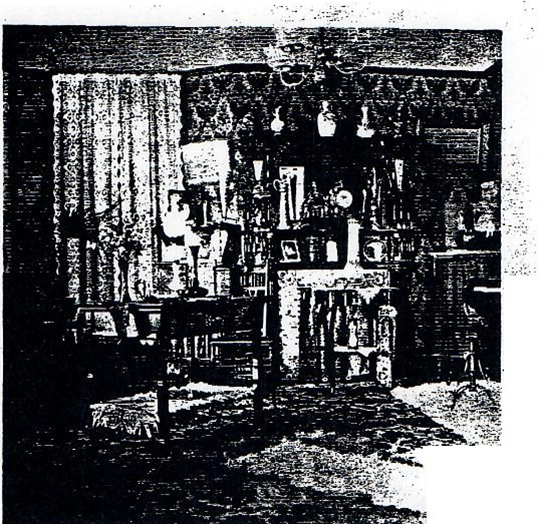
*3331 Washington Street, San Francisco 1903-1905 Jerome and family lived here after they sold the Jackson Street house
House in Mill Valley 1906 where Jerome and family lived after the earthquake. Helen, Leland & Clara
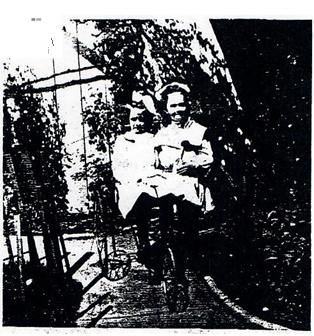
Esther & Helen in yard of Washington Street house
There was another of Mother’s episodic stories about I this period when the family was living in Mill Valley that we liked to hear. Helen had found a little lost kitten and Clara, under nagging pressure, had given in and let Helen keep the animal. Clara, however, had definite ideas about where four legged creatures should sleep and it certainly wasn’t in bed with one of her children. When Clara went upstairs to kiss Helen goodnight and found the kitten in the bed, she said, “You know better than to bring a cat to bed with you. Out the window it goes.” With that she picked up the cat by the scruff of the neck, walked deliberately to the window, opened it, and afparently tossed the cat out of the house, all to Helens wailing and pleas. Clara then closed the window and walked from the room. It wasn’t until years later that Helen learned that the kitten’s miraculous recovery the next day was because it had never been thrown out the window at all. The tape recording goes on: “Papa continued with the restaurant for a long time. I forget who all the waitresses were, but I think Belle Lathrop was one. I remember them always talking about Belle. Anyway it, the restaurant, was down close to the water front, because that was where everything was going on. “Many people had moved out of the city over to Oakland or Marin County. There were lots of people coming and going on the ferry boats, so places to eat along the Em- ‘ barcadero were really needed. “That’s where they began the cleanup job. Nobody 1 wondered what to do because they co·nscripted people just like for the army. They conscripted them to clean up the city. The only ones who got excused were men with famil ies who were needed at home or something. Even Grandpa was called up. They cleaned streets and all sorts of things. They were paid for it, but they had to do it.’’ A story my brothers and I especially loved to hear was another incident that occurred while they lived in Mill Valley. As I remember it: One day when Helen start ed out for school in the morning it was clear and cool, so Clara sent her daughter off with only a heavy sweater. 1 But by noon the black clouds were rolling in from the ‘ocean, bringing with them a heavy downpour.accompanied by thunder and lightening. When school was dismissed the storm seemed to be at its peak. Dauntless, Helen clasped her sweater about her and with her books in the bag she used for that purpose, she started down the path that led through the woods, the shortcut she always followed. The wind whistling through the trees were the screeching voices of the spooks and ghosts from all the tales Clara had read to her, that now filled the forest. In terror she ran toward the distant lights beyond the edge of the woods. Then she saw stretch ed out before her a huge fallen tree its tangled branches, like dancing arms reaching in all directions preventing any passage through their maze. Lightning crackled and lit up the sky, deepening the shadows around and filling them with fearful things, then thunder rolled and shook the ground. Carefully, Helen approached the barricade, seeking some way through the obstruction. Each time she tried struggling to push small branches aside great sheets of cold water drenched her, but finally she reached the trunk. It was too high to climb over. But the ground was • very uneven here and beneath the tree she saw there was just space enough to crawl through. Down on her hands and knees she went, unmindful of the mud. She causiously looked into the space through which she could reach the other side. It was clear of limbs at this point–if she could just slide under…. • Head first she started through the opening pulling her books in the bag after her. Lighting lit up the sky and at almost the same time a loud peal of thunder echoed through the woods and·she could feel the tree vibrate like a living thing. As if propelled by the forces of nature
J Helen squirmed free of the tree, but she could not pull
:J rJ J.. :J c ,
fl :I
the bag, as hard as she tried. It was caught on some thing. Hesitating only a few seconds, she left it there, books and all. As she stood up she regarded herself with Mama’s eye and worry about the mud replaced the fear of the forest and the storm. It wasn’t much farther and she would be home. She ran down the path following its familiar turn just before it came out across the road from her house. “Mama, Mama,” she cried as she ran in the front door. But no one answered and the gloom of the day filled the unlighted house. She sat down on a kitchen chair and cried. Suddenly she heard the front door open, and familiar footsteps approached the kitchen. It was Mama. After offering her daughter hugs and consolation, Mama explained, “I had to leave Leland next door. Then I walked to school to meet you with an umbrella, so you wouldn’t get so wet. When you weren’t there I was worried to death. Look at you. You look as if you’d been rolling in I the mud.” She held her daughter at arms length regarding her critically. Then Helen told of her frightening trip through the I woods, and again Clara comforted her and said, “We’ll get you new books. Now, a hot bath is what you need.” It was a story Mother never seemed to tire of telling, > nor we of hearing. “We came back from Mill Valley in ten months and I , • don’t think Papa had the restaurant after that. We went was out looking for work all the time then. I think prob 1 to live with the DeLong s in their garden house, and Papa ably the tents were all disbanded by that time, that is I all those places that weren’t going to be permanent.” 1 Many of the changes begun in 1902, primarily the uncertain work and worry about money, continued to be a way of life for the Stanford family, but as an aftermath of the earthquake their lives took a new direction.